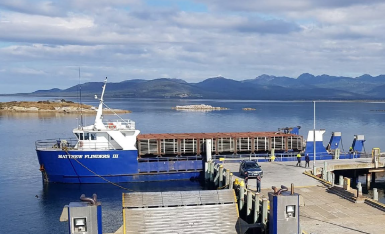
A cargo ship’s crew were unable to the use of the backup control system after a mechanical fault left the ship without steering for more than eight hours. The Australian Transport Safety Bureau (ATSB) said inadequate training on the system and unclear instructions in ship’s safety management system (SMS) contributed to the incident.
What happened
On 23 July 2025 at 2345, Matthew Flinders III was in transit between Bridport and Lady Barron, Tasmania, when a rudder angle feedback failure in its autopilot system caused a loss of steering. The failure caused both rudders to lock in the hard to port position and caused an uncontrolled turn to port. In response the ship’s master reduced engine power and alerted the engineer.
The crew attempted to rectify the problem but were initially unable to identify the cause of the failure. Unable to reinstate steering using the rudders – and rolling heavily in the moderate swell – the crew disconnected the steering gear from the rudder crossbar and centred the rudder manually, after which they regained limited heading control using different power settings on the ship’s twin propellers.
The ship slowly made its way back to Bridport, while the crew continued investigating the problem. At about 0815 the engineer identified a loose linkage arm associated with the steering control system. After re-tightening, steering was restored and the ship continued its voyage to Lady Barron.
What the ATSB found
The ATSB investigation found that the loose linkage arm caused a loss of rudder feedback to the autopilot system. This meant that neither the autopilot nor the follow-up manual steering modes were available.
The ship was fitted with a non-follow-up (or ‘toggle steering’) backup control system that was not dependent on the failed sensor. The toggle steering system was available throughout the occurrence and was engaged by the engineer in an attempt to reinstate rudder control. However, the master was unfamiliar with the toggle steering controls on the bridge and was unable to regain steering.
The ATSB also identified that induction training for new personnel did not adequately address the use of the backup control system and that the ship’s safety management system (SMS) did not include clear instructions on its use. Additionally, controls on the bridge were not labelled, and a simple changeover procedure was not posted as required.
Finally, emergency steering drills, which would have served to increase crew proficiency with the ship’s systems, did not include actual operation of the steering system in backup mode. Also, drills were not conducted at the required intervals, which meant that the master had not participated in any emergency steering drills.
What has been done as a result
Bass Strait Freight (BSF) has improved its familiarisation and induction processes to ensure its deck officers and engineers have a thorough understanding of the ship’s steering system. This included the employment of an experienced master in a checking role to assess competency of new crew. The ATSB has assessed that this safety action should adequately address the safety issue.
The company has developed and posted a simple procedure for switching between steering modes, which is posted on the bridge and in the engine room. However, this action does not adequately address the safety issue and further action through appropriate emergency steering procedures is necessary. Therefore, the ATSB has issued a recommendation to BSF to address this issue.
Safety message
Shipping companies are reminded of the importance of the availability of clear and simple instructions and procedures as part of their SMS. These procedures should include robust familiarisation processes. This is especially important on ships with non‑standard design features or unusual operational characteristics and for operators who may have a high turnover of casual crew.
Additionally, regular and thorough emergency drills are an essential part of ensuring and maintaining crew familiarity with their ship’s systems and emergency procedures. For steering emergencies, these drills should include practising steering in all available modes under controlled conditions while underway. This will greatly improve the chances of successfully dealing with an emergency situation.
Download the full report: ATSB MO-2025-009: Matthew Flinders III